 Birds Galaxy
Quick facts
| Also called | Green-cheeked Conure, Green-cheeked Parakeet |
|---|---|
| Size | About 25 cm |
| Weight | 60 – 80 g |
| Lifespan | 10 – 15 years, up to 30 with excellent care |
| Comes from | South America (Bolivia, Brazil, Paraguay, Argentina) |
| Eggs per clutch | Usually 4 – 6 |
| Incubation | About 23 days |
About green cheek conures
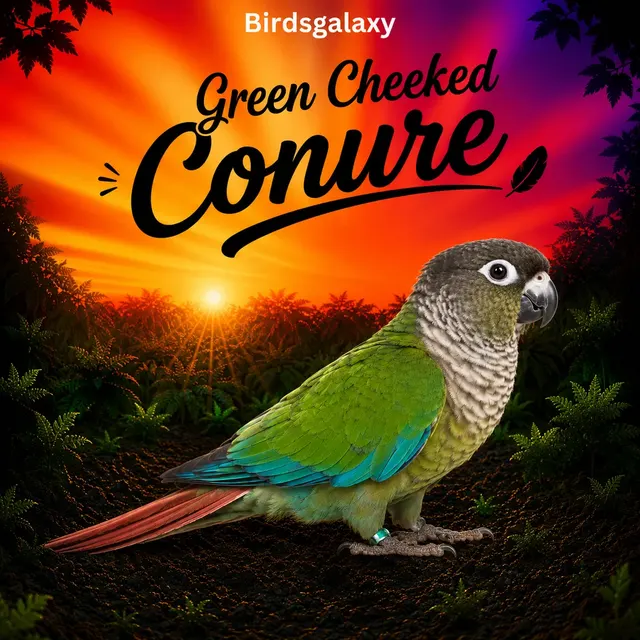
Green cheeks are small conures with an olive-green body, a maroon tail, a grey scalloped chest and blue flight feathers. They are clowns: they love to play, hang upside down, snuggle in a hand or a shirt, and explore. They are quieter than most conures, though not silent.
Cage and setup
Give at least about 60 cm long × 60 cm tall for one bird (bigger is better), with bars about 1.3 – 1.6 cm apart.
- Lots of toys: shreddable, foraging and climbing. Green cheeks get bored quickly.
- A snuggle hut or tent is popular, but some birds become hormonal or territorial with them. Remove it if your bird starts nesting in it.
- Time out of the cage daily, with supervision. Green cheeks are curious and get into everything.
What green cheeks eat
A quality pellet as the base, with fresh vegetables every day (leafy greens, carrot, sweet potato, peppers, broccoli, peas, corn) and some fruit. Sprouts and cooked grains or pulses are good extras. Seeds and nuts are best used as training treats.
Never give avocado, chocolate, caffeine (tea, coffee, cola), alcohol, salty or fried food, onion or garlic. Fruit seeds and pits (apple pips, cherry and peach stones) should be removed. Fumes from non-stick (PTFE / Teflon) pans and aerosol sprays can kill a bird in minutes, so keep birds well away from the kitchen.
Daily care and health
Daily fresh food and water, regular cleaning, baths (most love them) and lots of play and training. Bored conures can start screaming or plucking feathers.
Birds hide illness until they are quite unwell, so small changes matter. See an avian vet (a vet who treats birds) quickly if your bird:
- sits fluffed up for long periods, or sleeps much more than usual,
- stops eating, or loses weight (a kitchen scale in grams helps you notice),
- has a bobbing tail when breathing, clicks or wheezes,
- has droppings that change colour or become very watery for more than a day,
- has discharge from the eyes or nostrils, or sits on the cage floor.
Male or female?
Male and female green cheeks look the same. A DNA test from a feather or a drop of blood is the only reliable way to know.
Breeding green cheek conures
Breed only healthy adults, usually from around 1 – 2 years old, with a nest box of about 25 × 25 × 30 cm and wood shavings.
- A hen usually lays 4 – 6 eggs.
- Eggs hatch after about 23 days.
- Chicks leave the nest at about 6 – 7 weeks and wean a few weeks later.
Track clutches, egg checks and pedigrees in the free Birds Galaxy app.
Colours and genetics
Popular green cheek mutations include Cinnamon, Yellow-sided, Pineapple (Cinnamon + Yellow-sided), Turquoise, Mint, Pastel, Suncheek and Dilute. Cinnamon is sex-linked; Turquoise and Dilute are recessive.
The Birds Galaxy app has a green cheek conure mutation calculator with results for sons and daughters.
Buying and the law
Green-cheeked conures are listed on CITES Appendix II, so taking them across borders needs permits. Buy captive-bred birds from breeders you trust, and check your country's rules.
Track your birds, clutches and pedigrees, ask the Bird Care Assistant, and work out chick colours, all in the free Birds Galaxy app.
Get the appFrequently asked questions
Are green cheek conures loud?
They are quieter than most conures, but still call, especially in the morning and evening and when they want attention.
Can green cheeks talk?
Some learn a few words, but they are not strong talkers. They are better known for being playful and affectionate.
How can I tell if my green cheek is male or female?
They look the same, so a DNA test is needed.
What is a Pineapple green cheek?
A bird with both the Cinnamon and Yellow-sided mutations, giving a lighter body with yellow and red tones.
This guide is general information, not veterinary advice. If your bird seems unwell, contact an avian vet.
More care guides