 Birds Galaxy
Quick facts
| Also called | Budgerigar, parakeet (USA) |
|---|---|
| Size | About 18 cm |
| Weight | 30 – 40 g |
| Lifespan | 5 – 8 years (some live longer) |
| Comes from | Australia |
| Eggs per clutch | Usually 4 – 6 |
| Incubation | About 18 days |
About budgies
Budgies are small parakeets from the grasslands of Australia, where they live in big flocks. That flock life explains a lot: budgies are happiest with company, either another budgie or a lot of time with you. Many males learn to copy words and sounds.
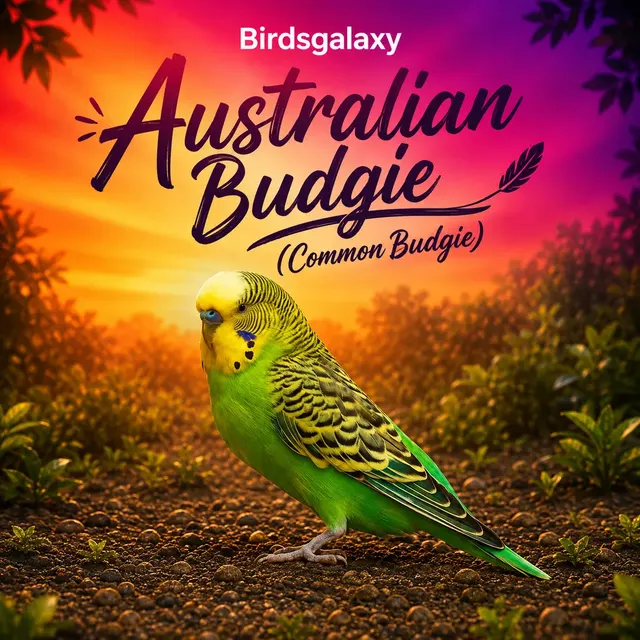
Wild budgies are green and yellow. Pet budgies come in a huge range of colours (see colours below). "English" or show budgies are bigger and fluffier than the standard "American" pet budgie, but care is the same.
Cage and setup
Budgies fly side to side, so pick a cage that is longer than it is tall, at least about 60 cm long for one or two birds and bigger for more, with bars about 1 – 1.2 cm apart.
- Several perches of different widths, set so the birds can hop and fly between them.
- A few toys (bells, ladders, shreddable toys), swapped around so they don't get bored.
- Food and water bowls placed away from perches so they stay clean.
- Daily time out of the cage in a safe room: windows closed, mirrors and glass covered, no other pets.
What budgies eat
Give a budgie seed mix or budgie pellets as the base, plus fresh vegetables and greens every day: broccoli, carrot, spinach, kale, peas, corn, peppers and herbs. Small amounts of fruit are fine as a treat. Millet spray is loved but fattening, so use it as a reward, not a meal.
Offer cuttlebone or a mineral block, and fresh water every day.
Never give avocado, chocolate, caffeine (tea, coffee, cola), alcohol, salty or fried food, onion or garlic. Fruit seeds and pits (apple pips, cherry and peach stones) should be removed. Fumes from non-stick (PTFE / Teflon) pans and aerosol sprays can kill a bird in minutes, so keep birds well away from the kitchen.
Daily care and health
Refresh water and food daily (blow the empty husks off seed bowls; the bowl can look full when it is only husks). Clean the cage floor every few days and wash everything weekly. Many budgies enjoy a shallow bath or wet greens to roll in.
A healthy budgie is alert, has smooth feathers, clean eyes and nostrils, and a clean vent.
Birds hide illness until they are quite unwell, so small changes matter. See an avian vet (a vet who treats birds) quickly if your bird:
- sits fluffed up for long periods, or sleeps much more than usual,
- stops eating, or loses weight (a kitchen scale in grams helps you notice),
- has a bobbing tail when breathing, clicks or wheezes,
- has droppings that change colour or become very watery for more than a day,
- has discharge from the eyes or nostrils, or sits on the cage floor.
Male or female?
In most adult budgies the colour of the cere (the skin above the beak) shows the sex. Adult males usually have a bright blue cere; adult females have a beige, tan or brown cere, often crusty brown in breeding condition. Young budgies of both sexes have a pale, pinkish cere, and some mutations (such as Lutino, Albino and Recessive Pied) keep a pink-purple cere in males, so a DNA test is the sure way.
Breeding budgies
Breed only healthy adults, at least about a year old, and give each pair a nest box with a concave base (no nesting material is needed).
- A hen usually lays 4 – 6 eggs, one every other day.
- Each egg hatches after about 18 days.
- Chicks leave the nest at about 4 – 5 weeks and are eating on their own a week or two later.
- Give extra soft food, greens and calcium during breeding, and no more than two or three clutches a year.
The free Birds Galaxy app tracks clutches, egg check dates and pedigrees for every pair.
Colours and genetics
Budgies have one of the richest colour ranges of any pet bird: Green and Blue series, Grey, Violet, Opaline, Cinnamon, Lutino and Albino, Spangle, Pied types, Clearwing, Greywing, Yellowface and many more. Some are dominant, some recessive and some sex-linked.
The Birds Galaxy app includes a budgie mutation calculator that shows the expected chicks of any pairing for sons and daughters.
Track your birds, clutches and pedigrees, ask the Bird Care Assistant, and work out chick colours, all in the free Birds Galaxy app.
Get the appFrequently asked questions
Should I keep one budgie or two?
Budgies are flock birds and are happiest with company. Two budgies are usually a good choice, especially if you are out during the day. A single budgie needs a lot of daily attention.
How long do budgies live?
Most pet budgies live about 5 to 8 years, and some live into their teens with a good diet and care.
Can budgies talk?
Yes, many budgies, especially males, learn words and short phrases by hearing them repeated often. Each bird is different.
How long do budgie eggs take to hatch?
About 18 days for each egg. Because eggs are laid every other day, the chicks hatch a day or two apart.
This guide is general information, not veterinary advice. If your bird seems unwell, contact an avian vet.
More care guides